
If you're printing a book and trying to decide between digital and offset, the real question isn't which is better; it's how many copies you need.
Once you get into higher quantities, especially with a format like a 144-page book (built on 48-page signatures), web offset presses start to pull away fast on cost.
Let's walk through why and where that tipping point usually lands.
Why a 144-page book is a sweet spot
A 144-page book breaks down cleanly into 3 x 48-page signatures.
That matters because web offset presses are optimized to run large, efficient forms. When your page count aligns with the signature sizes, you get:
- Minimal paper waste
- Efficient press layouts
- Smoother folding and binding downstream
In short, it's a format that lets offset do what it does best: run clean and run fast.
The cost structure and what you're really paying for
With web offset, your costs fall into two buckets:
Fixed costs- Plates (for each signature and color)
- Makeready and setup time
- Startup waste
These costs are the same whether you print 2,000 or 200,000 copies.
Variable costs
- Paper
- Ink
- Press time (very low once running)
And this is where offset wins: once you're up to speed, the cost to print each additional book drops significantly.
Makeready: still the gatekeeper
Even with modern automation on web offset presses, there's still an upfront "entry cost."
- Each of the 3 signatures requires setup
- Color has to be dialed in
- Registration has to be locked
So instead of one setup, you're effectively running three efficient but real makereadies. That's why volume matters so much; you need enough copies to spread those costs out.
What the cost curve looks like
Think of it like this:
-
Digital printing = steady, predictable cost per book
- Web offset = higher upfront cost, then a steep drop
With a 144-page book, that drop happens faster than you might expect because more pages = more impressions digitally, and offset cost doesn't scale the same way.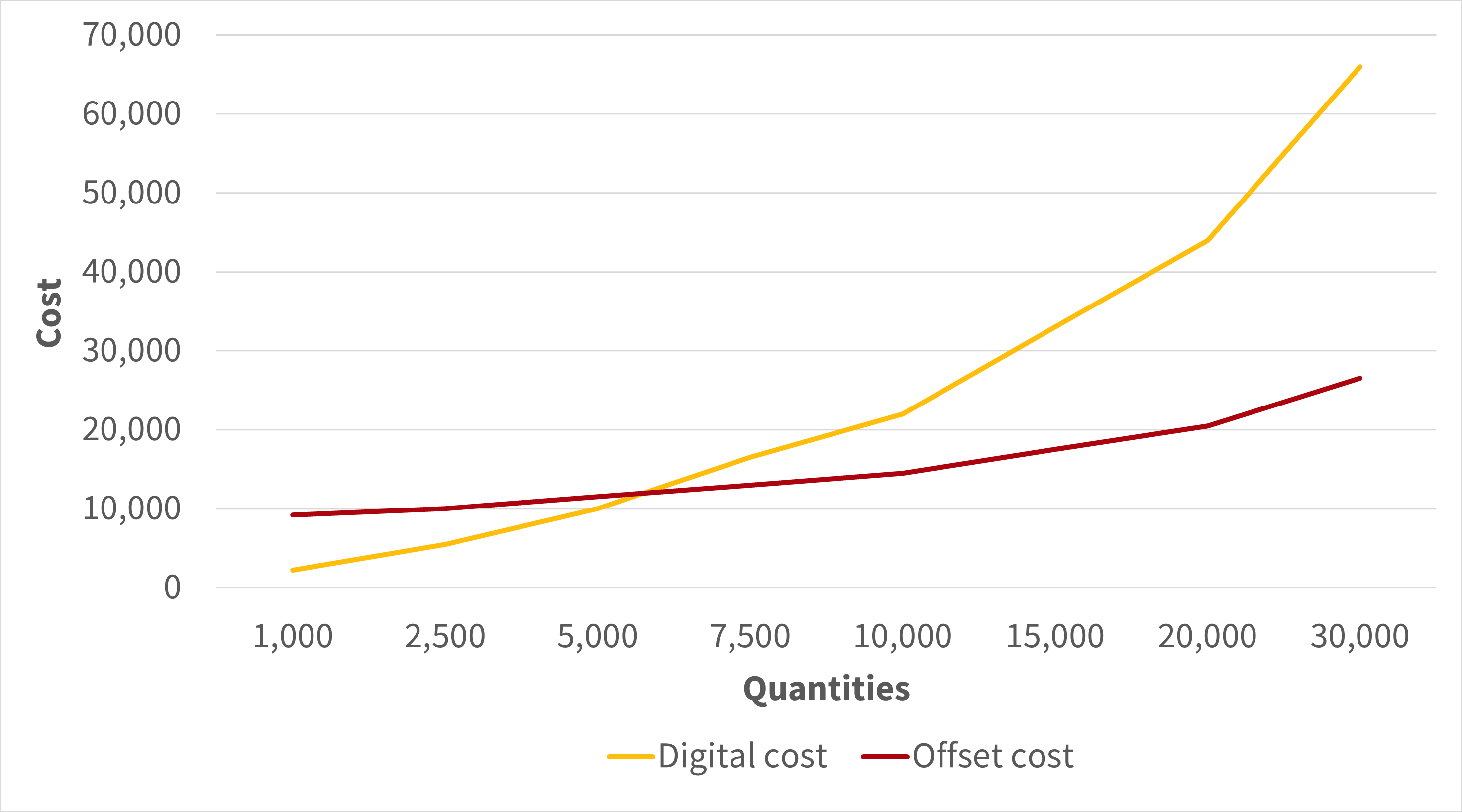
Real-world quantity breakpoints
Here's where things typically land for a book that's 144-pages:
Under ~2,500 copies ⟶ digital wins
- Too few units to absorb 3 signature setups
- Digital's simplicity outweighs offset's efficiency
Best for short runs, pilots, or limited releases.
2,500-7,500 copies ⟶ the decision zone
-
Offset starts becoming competitive
- Page count begins to favor offset
- Still depends on specs and timing
Worth pricing both, as this is where surprises can happen.
15,000-30,000 copies ⟶ strong offset territory
- Long, efficient runs
- Lower labor and handling due to inline processes
- Significant savings vs. digital
Ideal for education, trade, and recurring titles
30,000+ copies ⟶ peak efficiency
-
Exactly what web offset presses are built for
- Continuous printing, minimal interruptions
- Lowest possible cost per book
At this point, offset isn't just better; it's hard to beat.
A practical rule of thumb
A 144-page book built on 48-page signatures is almost tailor-made for web offset. Digital will always have a place for speed and flexibility, but once volume picks up, the math shifts quickly.
With the right page count and enough copies, offset doesn't just compete - it scales in a way that digital can't. And that's really the whole story: the more you print, the more those upfront costs fade and the more offset pays off.